Advanced Systems, Computational Fabrication & Archival Doctrine
HEAV3NS publishes formal position papers, executable contracts, and computational instruments that transition creative engineering from corporate software churn to intent-driven fabrication, bounded multi-agent execution, and 30-year archival preservation.
Intent-Driven Development
This paper proposes intent-driven development (IDD) as a mode of computational fabrication in which an artist or director specifies an intended form, agent systems repeatedly transform repository material, and executable contracts and acceptance evidence constrain the resulting artifact. The proposed cycle—Repository → Prompt → Heat → Prompt → Heat → Mold → Output—draws an analogy to pressure molding rather than conventional application product management. HEAV3NS-CODE is positioned as a computational instrument through which this practice can be explored, not as a universal agent architecture, a required methodology, or a continuously evolving commercial product. The paper separates artistic conception from machine execution, distinguishes behavioral contracts from user-facing gameplay, and identifies both the value and limits of treating source repositories as mutable fabrication material.
“The proposed cycle—Repository → Prompt → Heat → Prompt → Heat → Mold → Output—draws an analogy to pressure molding rather than conventional application product management.”
BROCWIN: The Environment as an Executable Artifact
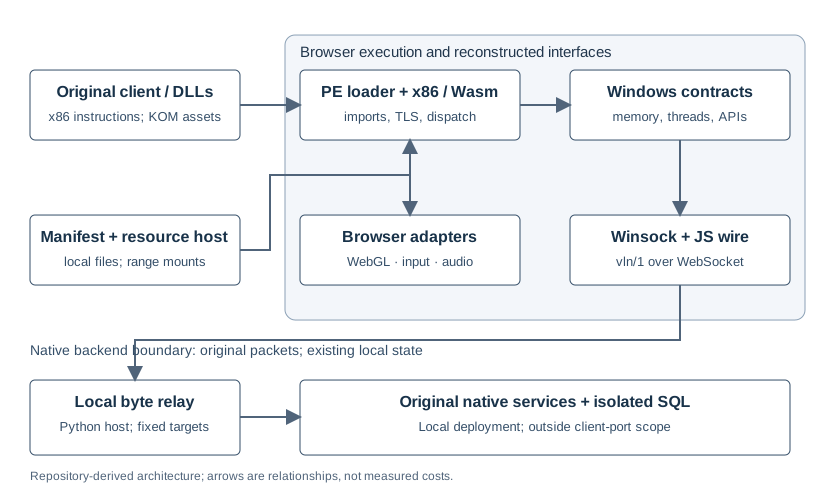
BROCWIN makes the conditions of software execution available as a subject of curatorial attention. Developed through the HEAV3NS-COMBO experiment, it combines an inherited x86 interpreter in WebAssembly, reconstructed Windows interfaces, browser graphics and local native services to execute a supplied legacy MMO client. Retained control observations reach the original login interface after 440.703 seconds with a fresh browser profile and 438.797 seconds with a reused profile. This paper interprets the surrounding environment as an executable artifact: a constructed arrangement whose operation makes another historical artifact accessible. It distinguishes that interpretation from the project’s limited experimental achievement. Neither complete gameplay compatibility nor durable archival execution has been established. The decision to close engineering leaves a bounded research object, including failures, source differences and uncertain claims, for future custody. Its institutional value lies in making preservation’s dependencies and judgments legible.
“Preserving a legacy executable is not merely possession of its binary; the environment itself is a constructed, executable artifact whose operation makes cultural history accessible.”
Core Ontological Disciplines
Computational Fabrication
Formalizing the shift from manual code instruction writing to boundary-setting: repository plasticity, directed computational heat, behavioral contract molds, and acceptance evidence.
Synthetic Runtimes & Archaeology
BROCWIN: Browser-hosted execution of legacy Windows binaries in WebAssembly, reconstructed Win32 contracts, 440s boot observations, and the environment as an executable curatorial artifact.
Autonomous Physical Media
Translating virtual contractual states into physical trading card press manufacturing: precision lithography, holographic foiling matrices, and cryptographic NFC hardware serialization.
Cognitive Governance & ACI
Anti-spiral self-healing architectures, multi-agent telemetry, sovereign checkpointing, and peer symmetry to defend against concentrated commercial foundation model lock-in.
The Pressure Molding State Diagram
⚙The Fabrication Cycle: Interactive Stepper
METAPHOR: PRESSURE MOLDING & COMPUTATIONAL HEATSTEP 01: Repository — The Mutable Material
Code, tests, assets, configuration, and retained state.
Working Papers & Dispatches
Intent-Driven Development
This paper proposes intent-driven development (IDD) as a mode of computational fabrication in which an artist or director specifies an intended form, agent systems repeatedly transform repository material, and executable...
BROCWIN: The Environment as an Executable Artifact
BROCWIN makes the conditions of software execution available as a subject of curatorial attention. Developed through the HEAV3NS-COMBO experiment, it combines an inherited x86 interpreter in WebAssembly, reconstructed Wi...
BroccoliQueue & Topological AST Auditing
Formal analysis of decoupled AST parsing, AST cache invalidation guarantees, and non-blocking background queue semantics under persistent local LLM inference.
Autonomous Physical Artifacts & Algorithmic Geometry
Investigates the boundary crossing between executable digital card mechanics and physical manufacturing workflows: lithography, holographic foiling, and cryptographic NFC serialization.
Cognitive Autonomy in Decentralized Multi-Agent Swarms
Extends Amendment I doctrine into runtime telemetry: quantifying agent divergence, sovereign local checkpointing, and topological self-containment against upstream model lock-in.
The 5 Directorial Acceptance Invariants
Behavioral Contracts over Guesswork
Objects are defined as declarative bundles of entry conditions, state schemas, and verified exit rights, rather than relying on unpredictable stochastic agent emergence.
Empirical Verification over Plausible Diffs
A persuasive prompt or syntactically valid code diff does not establish conformance. The artifact must pass deterministic test suites and regression harnesses before acceptance.
Human Directorial Custody
Delegating code implementation to inference models does not remove authorial responsibility. The director retains ethical, legal, and artistic accountability for every accepted line.
8-Vector Archival Provenance
Preserving an executable edition requires locking source Git commits, pinned toolchains, asset bitstreams, and test harnesses rather than assuming eternal cloud hosting.
Intellectual Honesty on Boundaries
Known failure modes, probabilistic non-determinism, and performance ceilings are explicitly retained in the provenance log rather than covered up with production hype.
Peer Review, Verification & Academic Coordination
HEAV3NS welcomes independent scholarly study, adversarial replication, and fork validation from researchers in programming language theory, autonomous systems, and digital preservation. Access canonical schema definitions or consult MAJO AI Synthetic Resident.